


A Guide to Laying Tile Patterns
A Guide to Laying Tile Patterns
How to Choose and Lay the Perfect Design
Dreaming of a beautiful new design in your home? Choosing the right tile patterns can completely transform a space by adding pattern and texture in just the right ways. Whether you're designing a serene bathroom, a statement kitchen splashback to catch the eye, or a casual aesthetic in a durable outdoor entertaining area, the patterns of your chosen tile are a detail that shouldn't be underestimated.
Your pattern selection doesn't just influence the overall look of your space, it will impact how large a room feels, how it reflects and expands light and especially how practical the surface is to withstand the most energetic of family life in everyday use.
In this guide, we'll walk you through the journey of choosing the right tile pattern for your dream space, including the most popular options right now, how to lay them and how to choose the best designs for all floor, wall and outdoor areas.
Why Tile Patterns Are Important
Before we consider the specific tilings for your current space, it's important to understand their impact on the surface. The same tile can look entirely different depending on how it's laid. Clever patterns can:
- - Make small spaces feel large, airy and open
- - Add movement and visual interest for the eye
- - Highlight architectural features specially chosen for your home
- - Improve important slip resistance
- - Create a cohesive flow between indoor and outdoor zones
If you're starting your project, it's worth exploring our full range of tiles. Shop all tiles today to find a base tile that sets the standard for your vision.


Popular Tile Patterns & How to Lay Them
Stacked Pattern
Otherwise known as a Straight Lay, this is the simplest of all tile patterns. Tiles are placed in a grid where edges align perfectly, creating crisp lines and a calm, uncluttered feel. It's a natural fit for contemporary interiors, and pairs especially well with our large format porcelain tiles in soft stone or concrete finishes, matched with a toning grout for a continuous aesthetic.
Best for:
- - Modern floor spaces
- - Minimalist bathroom walls
- - Large format tiles on significant surfaces
How to lay it:
- - Begin at the centre of the room or wall
- - Use spacers to maintain even grout lines
- - Work outwards in straight rows
- - Check alignment regularly with a spirit level, as even small shifts become visible in a grid layout
This pattern suits many tile sizes. Shop by size to find the perfect proportions for your space.


Brick Bond Pattern
The Brick Bond (or Running Bond) offsets each row by half, or sometimes a third, of a tile, mimicking traditional brickwork for a timeless appeal. A dynamic grout contrast or handmade-style finish can add warmth and character, which you can bring to life with a brick look tile from our range for kitchens and bathrooms.
Best for:
- - High-traffic hallways and living areas
- - Feature walls to catch the eye
- - Subway tile splashbacks in kitchens and bathrooms
How to lay it:
- - Begin with a full tile in the first row
- - Start the next row with a half tile to create the staggered effect
- - Continue alternating rows for your pattern to reveal itself
- - Keep a consistent offset (half or third) throughout for a professional finish
This is one of the most popular subway tile patterns, especially for splashbacks. Learn more about bathroom tile installation here.


Herringbone Pattern
The herringbone is one of the most striking tile patterns, creating a visually appealing zigzag effect that adds movement and sophistication to every space.
Right now, interiors are shifting away from flat, uniform surfaces and prioritising designs that offer depth and personality within your home to make it truly yours. Herringbone delivers exactly that. The directional layout draws the viewer's eye across a space, creating the illusion of expanse and offering a touch of luxury for modern and classic styles.
Achieve this look with a slim rectangular porcelain or stone-look tile in crisp whites in our range.
Best for:
- - Statement floors that create dynamic interest
- - Feature walls designed to catch the eye
- - Inviting entryways that set the standard for your home immediately
How to lay it:
- - Snap a chalk line down the centre of your surface as a guide
- - Lay tiles at precise 45-degree angles to the guideline
- - Align each tile end to the side of the next to form a 'V' shape
- - Work outward from the central line, and dry-lay a section first to check alignment before committing with adhesive
Herringbone can be more complex to install, but the visual impact is well worth it. For best results, use professional-grade adhesives and tools from our installation materials range.


French Pattern
The French pattern (or Versailles pattern) uses a combination of different-sized tiles arranged in a repeating, interlocking layout. The result is an organic, seemingly random aesthetic that feels both structured and relaxed, perfect for an elegant outdoor family space.
Rustic luxury is a defining trend in Australian outdoor design now, as homeowners lean into natural textures and earth palettes that create a seamless transition between indoor and outdoor living. With a French pattern set tile you can evoke the charm of European courtyards while ensuring the durability needed for alfresco entertaining in Australia. View other options for your exterior spaces in our outdoor tiling range.
Best for:
- - Outdoor entertaining areas and courtyards
- - Surrounding the backyard pool
- - Garden pathways to create a touch of whimsy
- - Transitional spaces between indoor and outdoor living
How to lay it:
- - Familiarise yourself with the pre-set modules of the French pattern, typically four tile sizes arranged in a repeating block
- - Begin from a straight edge or central point, laying out one full pattern at a time
- - Dry-lay several modules to ensure the pattern flows correctly
- - Then work in sections to repeat the pattern and check alignment as you go


Basketweave Pattern
A decorative option with real character, the basketweave (or cross-hatch) uses rectangular tiles arranged in alternating pairs or trios to mimic the look of woven fabric. It's a natural fit for heritage-inspired interiors and adds a softness that more geometric patterns can't replicate. Consider a premium natural stone in one or two colours to achieve this timeless look. Browse classic palettes of white, grey and natural from our range, ideal for bathrooms and feature floors.
Best for:
- - Heritage-style homes
- - Serene bathroom floors
- - Feature areas that deserve a point of difference
How to lay it:
- - Group two or three tiles side by side horizontally, then place the next pair vertically to create the woven effect
- - Use a consistent tile size throughout (rectangles with a 2:1 or 3:1 ratio work best)
- - Dry-lay a section first to establish the rhythm before fixing with adhesive
- - Repeat the pattern consistently, maintaining even spacing so the woven illusion holds


Chevron Pattern
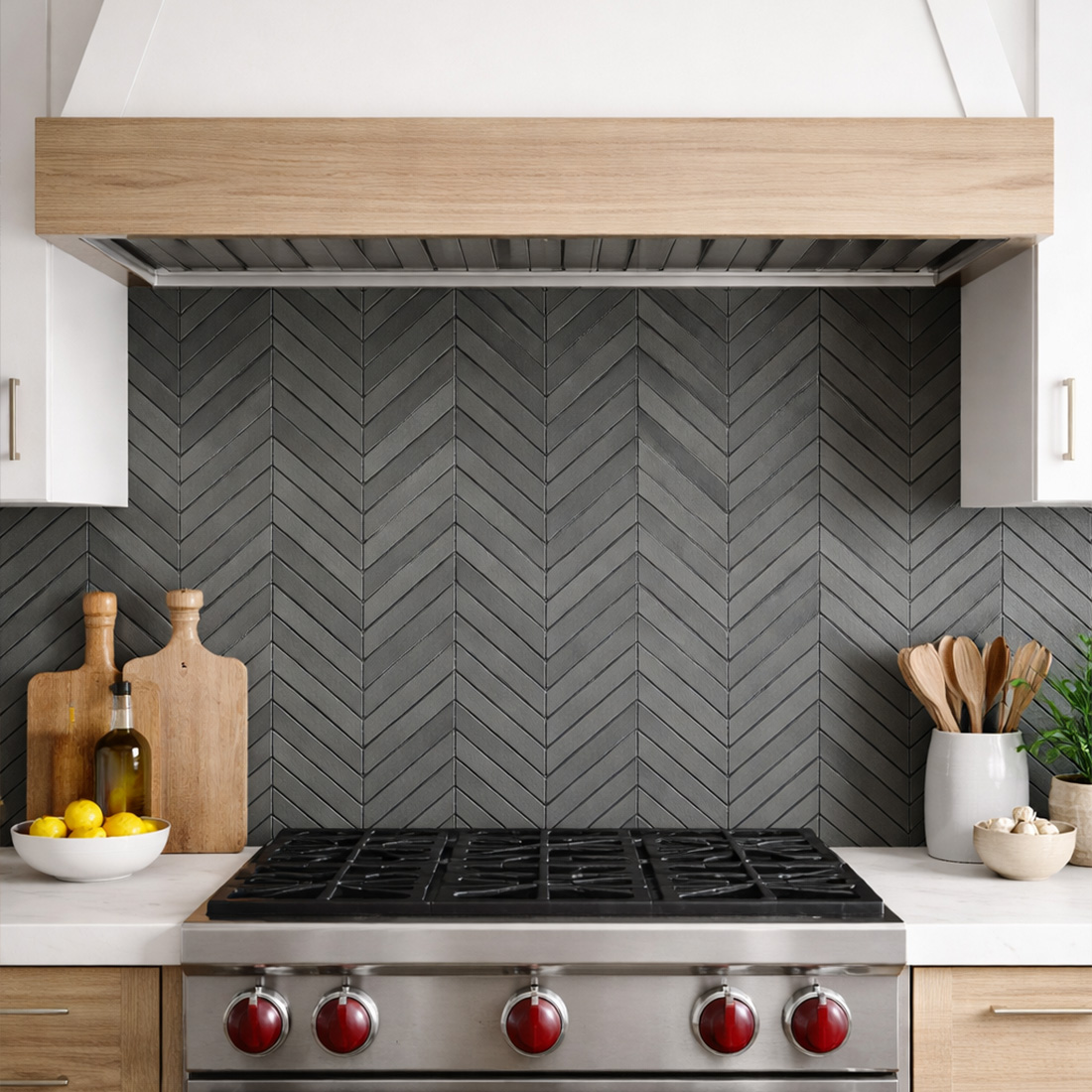
Often confused with herringbone, the chevron pattern uses tiles cut at angles to create a continuous, symmetrical 'V' shape to lift your space. Where herringbone produces a zigzag, chevron creates clean, pointed lines, reducing visual clutter while still delivering architectural interest. For a sophisticated finish, view chevron options in pre-cut mosaic styles for a flowing pattern that is both elegant and design-forward.
Best for:
- - Contemporary interiors
- - Architectural feature walls
- - Luxury bathrooms with visual dynamics
How to lay it:
- - Use pre-cut angled tiles (chevron tiles are specifically manufactured with mitre-cut ends)
- - Align edges precisely to form sharp points, as even minor misalignment is noticeable in this pattern
- - Maintain consistent spacing throughout with tile spacers
- - Work from a central guideline outward to keep the 'V' shapes symmetrical

Choosing the Right Tile Pattern for Your Home
With so many patterns to choose from, the decision comes down to balancing three things: the look you want, the space you're working with and how the surface needs to perform.
Room size and shape play a bigger role than most people expect. In smaller rooms like ensuites or laundries, a stacked pattern with large-format tiles and toning grout can make the space feel more open by minimising visual breaks. In larger living areas or open-plan spaces, patterns with more movement (herringbone, chevron) give the floor a sense of direction and stop the space from feeling flat.
Walls behave differently to floors. A vertical stacked or subway pattern will draw the eye upward and elongate a room's height, which works particularly well in bathrooms with lower ceilings. Feature walls are where bolder patterns like herringbone or chevron can shine without overwhelming the space, especially when paired with a simpler layout on surrounding surfaces.
Outdoors, durability and grip come first. Textured finishes and the French pattern are popular choices for entertaining areas and pool surrounds because they handle foot traffic, moisture and weather. Linear patterns can also work well to guide movement along a garden path or define zones in an alfresco space.
If you're unsure, start with one feature area. A splashback, an entryway or a bathroom floor is a low-risk way to introduce a more expressive pattern before committing to it across a larger space. You can always keep surrounding areas in a simpler stacked or brick bond layout to let the feature do the talking.
Our team can help you match patterns to your space, lifestyle and budget. Get in touch or visit your nearest showroom to see how different patterns look and feel in person.
Ready to Start Your Project?
The beauty of tile lies in its versatility. With so many patterns, layouts and finishes to choose from, you can create a space that reflects your lifestyle and your unique style. Start browsing today and bring your vision to life.